
A Short Review of 'Strangers to Ourselves'

Toward getting proximate to suffering until it makes sense
Why do people do the things they do? Competing theories arise in every age. The more popular an explanatory idea becomes, the more it’s exercised to extremes, only to be answered with a countervailing idea which, again overshoots in the other direction. The pendulum swings. The ship is tilted to starboard, then all the shipmates run to port and it tilts too far in the opposite direction.
In Strangers to Ourselves, Rachel Aviv does not overshoot in her explanations. Aviv shares the stories of four people’s struggles with mental illness, bookending these portrayals with her own story as a six-year-old diagnosed and hospitalized with anorexia, and manages to undo all tidy explanations. Aviv’s close telling illustrates the power of individual and collective meaning making in shaping a person’s experience of mental illness, how it develops, and how it is expressed in reciprocal action with a person’s context.
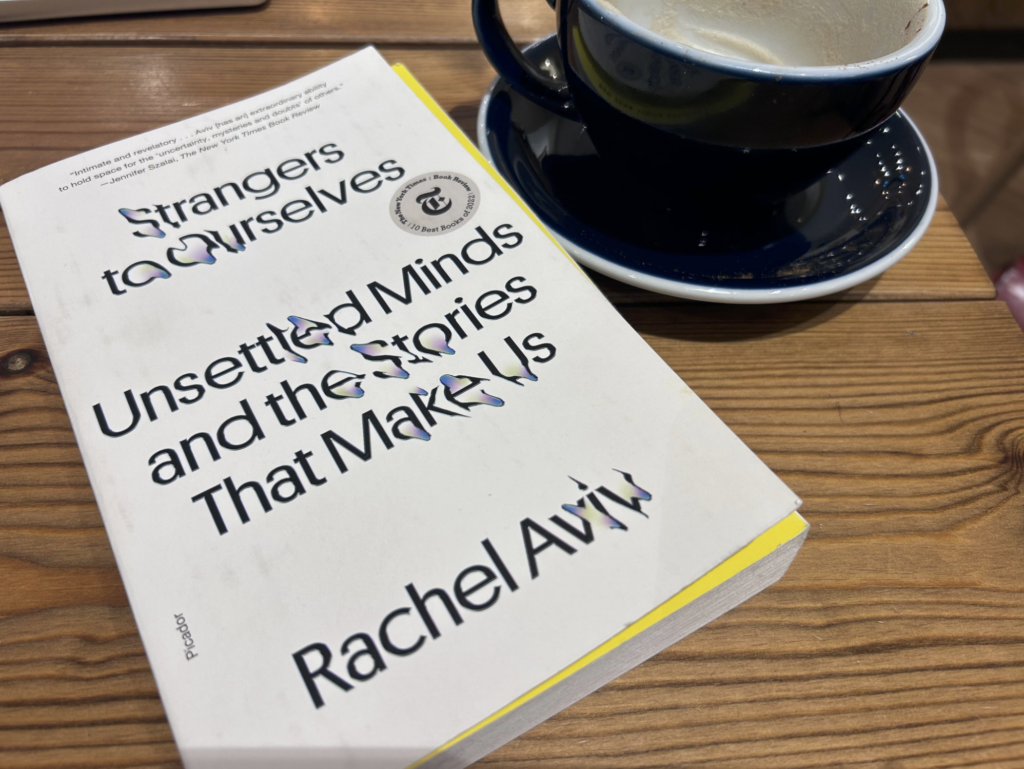
Her thesis, that people need their suffering to be legible, to not be alone with their suffering, and to make sense of their struggles, is not controversial. Yet is commonly and disastrously overlooked. Aviv’s capacity to sit with the messiness and ambiguity of her subject’s stories (sometimes, as in the case of Laura Delano, moreso than the subjects themselves can manage to do) without being pulled into any “single story” explanation makes her reporting both illuminating and instructive.
As a post-doctoral student of Dialectical Behavior Therapy, or DBT, I was taught that all behavior is caused. Nothing comes from nowhere. When I started running my own DBT skills groups for teens, I reformulated this DBT “principle” in language I thought might provide a useful starting place for my patients: “Everything I think, do, and feel makes sense in some way, even if I can’t see how.” It became a sort of mantra I would teach the teens who came to me insisting that what they did (often self-destructive) and how they felt (intensely) was “stupid” and “crazy.”
Having studied mostly literature in college—not psychology—I came to see that people could be understood the way we understand a well written character in a novel. In a good piece of literature, we might feel frustrated at our beloved characters for doing what they do, but we can see how it all makes sense. If not at the beginning of the story, at least by the end, the skilled author weaves together a story in which everything was leading up to this. Whether tragic, comic, or a mix, nothing in the story comes from nowhere.
Aviv tells the stories of four real people, not characters. But through extensive research, interviews, and careful curiosity and sociological contextualizing, Aviv makes sure each person’s narrative coheres. Each person she features has a multitude of factors driving their story. One opens with a scene that is especially baffling, or polarizing to those who seek tidy explanations: a mother crossing a bridge in Minnesota on the Fourth of July throws her two young children off it, and then herself jumps.
For the rest of this section of Strangers, we are reading on to find out how this could have come to be. The young mother, Naomi, it turns out, had not come to this point by merely “going crazy” as if that were a simple option. I can hardly summarize all the factors that led to her tragic moment on the bridge, as the nuance and the interactive complexity are the point. It was intergenerational trauma, it was racial oppression, it was modern conspiracy theories, it was an inherited predisposition, it was exquisite sensitivity and accurate perception of cruelty in a cruel world, it was unprocessed loss, it was lack of adequate mental health care, it was the breakdown of a system of personal meaning in which hope and help felt less realistic than desperate action.
And this, I believe, is Aviv’s central proposition. Mental illness doesn’t just follow from a single cause. No matter what we assume that single cause to be, we are wrong, and we do harm to the sufferer by constraining their story to a simple formula.
As a clinical psychologist, I work with individuals to help them find individual ways forward. This does not release me from taking into account the sociological, systemic, historical, biological, familial, and environmental factors at play. My role is to help an individual make sense to themselves, taking all these factors into account. When someone makes sense to themselves, it is possible to create a storyline in which their life has meaning. No matter the level of suffering, when people are restored to dignity, belonging, and purpose, it is possible to construct a better path forward. When people make sense to themselves, their humanity is centered and their agency becomes the driver of health. Then they can begin to find and make use of whatever exists (in the mental health field and in the wider world) that might support them.
As adults, people are responsible for their own actions. Listening with curiosity doesn’t imply letting people “off the hook.” And in fact, when people feel less alone, better understood, and are able to begin to make sense to themselves, they have a chance of connecting to their own agency regarding what is in their control and what is outside of it. As a society, we seem to have a hard time connecting to this type of agency. When we chalk up extreme behaviors or mental illness presentations to extremely individualized pathology, or to extremely overpowering systems, we miss the mark either way and reinforce the idea that as a society, there’s nothing we can do.
Our job, not only as mental health professionals, but as a society asking, “why do people do the things they do?” is to not stop asking once the first or most obvious explanation is offered. We must continue asking the question without prejudgement, with genuine curiosity and willingness to “get proximate” as Bryan Stevenson recommends. Especially when what people do is baffling or destructive. Mental illness does not exist apart from meaning-making. Neither does mental health.